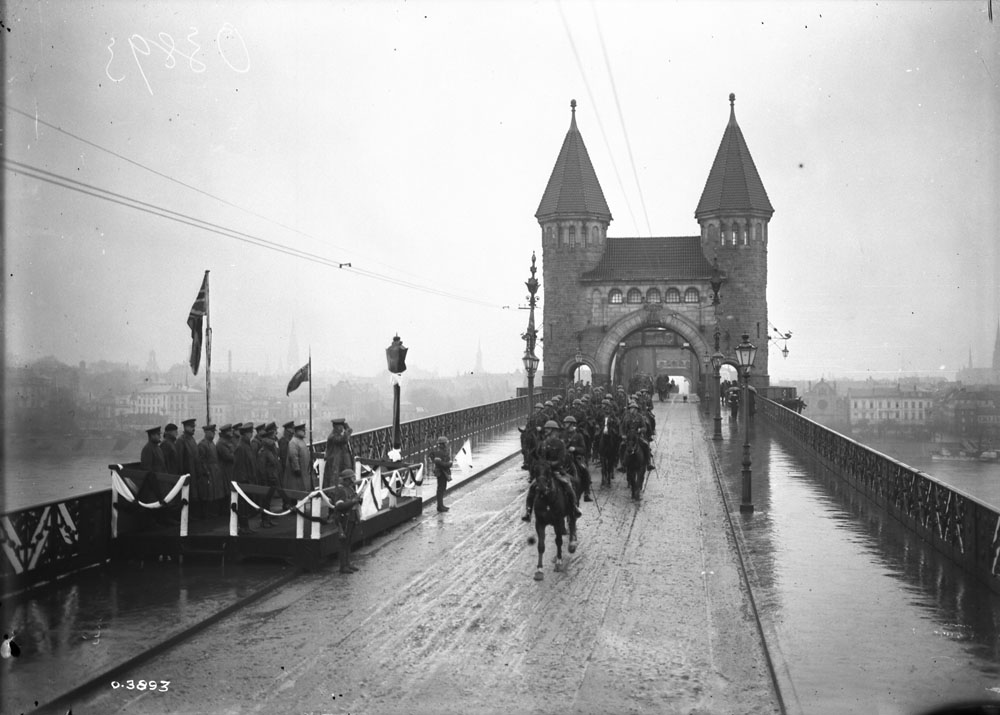
The CLH formed as the Canadian Corps Cavalry Regiment in May 1916. By the amalgamation of three divisional cavalry squadrons: the 1st Divisional Cavalry Squadron (19th Alberta Dragoons), the 2nd Divisional Cavalry Squadron (1st Hussars), and also the 3rd Divisional Cavalry Squadron (16th Light Horse) of the Canadian Cavalry Brigade (CCB).

The Canadian Cavalry Brigade (CCB) spent the war majority of the Great War as part of the British Cavalry Corps, and largely supported British operations. The 19th Alberta Dragoons (19AD) became the 1st Divisional Cavalry Squadron in 1914. The 1st Hussars (1H) became the 2nd Divisional Cavalry Squadron in 1915. Finally, the 16th Light Horse (16LH) became the 3rd Divisional Cavalry Squadron in 1916. In June 1916, these three Divisional Cavalry squadrons amalgamated into one regiment called the Canadian Corps Cavalry Regiment (CCCR). In March 1917, the Regiment renamed the Canadian Light Horse (CLH).
Background
On 29 March 1915, Ibbotson Leonard met with Sam Hughes and General Hodgins in Ottawa to discuss the formation of the 2nd Divisional Cavalry Squadron. Leonard used his influence to ensure that his regiment, the 1st Hussars, would be chosen for the job. Sure enough, on 30 March 1915, the 1st Hussars selected to supply the Divisional Cavalry Squadron for the 2nd Canadian Division. Promptly relieved from their duties as “A” Squadron of the 7th CMR.

Lieutenant James William Carroll, aged 53, passed away on 13 March 1915 and buried at BATTLEFORD (MUNICIPAL) CEMETERY, Saskatchewan. Formerly of the Canadian Mounted Rifles. Son of James and Maria Carroll, of Mullingar, Ireland. Husband of Sarah A. Carroll, Battleford South, Saskatchewan.

Lieutenant Colonel Leonard offered command of the Squadron, but would be demoted to the rank of Major. However, he met with Hughes in Chatham on 9 April and assured he would retain his rank. A promise confirmed on 21 May 1915.
England
Training and regular classes continued until orders to embark for England finally came on 6 June 1915. Leonard’s unit of six Officers and 166 Other Ranks left London for Montreal on 8 June 1915. Sailing for England on 9 June aboard the S.S. Caledonian, also with members of the Royal Canadian Horse Artillery.

The 1st Hussars voyage became all the more precarious as they approached England. They came under threats from German submarines. Following a total of thirteen days at sea, the Hussars disembarked Plymouth by 1:00pm on 22 June. Then boarded their train to the Canadian Cavalry Depot in Canterbury by 4:00pm. On 25 June, Leonard met with Sam Steele at Folkestone, and learned that the regiment would be sent to train at Shorncliffe with the 2nd Canadian Division on 27 June.

Lance-Sergeant William Henry Pryce 1915 died 28 August 1915 and buried at BAILLEUL COMMUNAL CEMETERY EXTENSION, NORD. Son of Mrs. A. E. Pryce, of 35, Pentonville Rd., Islington, London, England, and the late Mr. J. W. Pryce.
France
As autumn approached, the 1st Hussars prepared to embark for the front with the 2nd Canadian Division. On 1 September 1915, Leonard met with Hughes and Folger to discuss departure arrangements. On 16 September the men of the 1st Hussars left Otterpool Camp for Southampton and crossed the Channel, landing at Le Havre. They proceeded to the Belgian town of Westoutre, south west of Ypres.

The 2nd Divisional Cyclists also grouped together with the 2nd Divisional Cavalry as a body of “mounted troops.” The change increased the number of men under Leonard’s command from 161 to 366.

The 1st Hussars began Divisional Cavalry work immediately upon arriving at the front. From 21 September until 1 October 1915, the 1H reconnoitred and mapped the second and third line of General Headquarters (GHQ) trenches. As Divisional Cavalry required to act as dispatch riders and escorts for the infantry. While there was no opportunity to use cavalry in battle in 1915, the men of the 1st Hussars busy in their Divisional Cavalry role for the remainder of the year. They were continuously engaged in mounted patrol work. Trench mapping, assisting divisional engineers, classifying water supply, artillery reconnaissance, and stretcher bearing.
Special Services Squadron, 1st Hussars
On 4 October 1915, the 1st Hussars took over as frontier guards at the Belgian-French borde. Along with ninety men from the cyclist battalion. Like the Canadian Cavalry Brigade, all members of the 1st Hussars concerned with the preservation of their regimental identity in late 191. They were operating under the name of “2nd Divisional Cavalry Squadron,” and sometimes referred to as the 7th Canadian Mounted Rifles from which they were recruited.

On 2 November 1915, Leonard visited General Headquarters to request that the regiment be reassigned to their original militia identity and be renamed the Special Services Squadron, 1st Hussars. On 31 January 1916, the 2nd Divisional Cavalry Squadron was officially re-named the Special Services Squadron, 1st Hussars. The 1st Hussars contributed personnel (66 individuals) to the 1st Battalion, CEF.
Remounted
The Canadian Cavalry Brigade remounted in January 1916 in anticipation of a mass cavalry breakthrough at the Somme, scheduled to open on 1 July 1916. The 2nd Indian Cavalry Division would see action at High Wood on 14 July, with the Canadian Cavalry Brigade among them.

On 3 January 1916, Brigadier General J. E. B. Seely addressed his troops at 12:30pm to inform them that they would be remounting. The CCB became part of the 1st Indian Cavalry Division on 26 January 1916. Also in January 1916, the 2nd King Edward’s Horse left the Canadian Cavalry Brigade, and replaced by the Fort Garry Horse from Winnipeg. The Canadian Divisional Cavalry regiments also faced organizational changes in 1916. The 19th Alberta Dragoons and the 1st Hussars carried on with training and Divisional Cavalry work until mid-May when the 1st, 2nd, and 3rd Divisional Cavalry Squadrons merged into a single unit that would serve as the Divisional Cavalry for the entire Canadian Expeditionary Force.
Private George Adolphus Bishop 15061 killed-in-action 7/8 February 1916 (BAILLEUL COMMUNAL CEMETERY EXTENSION, NORD). While in a working party n subsidiary lines, sniped and killed by a single bullet.
Canadian Corps Cavalry Regiment (CCCR)
The CCCR officially formed on 19 May 1916 at Abeele, Belgium under the command of Lieutenant Colonel J.H. Elmsley of the RCD. The 19th Alberta Dragoons became “A” Squadron of the Squadron of the CCCR, the 1st Hussars became “B” Squadron, and the 16th Light Horse became “C” Squadron. Although they had been amalgamated into a single force, all regiments retained their original militia identities and commanding officers, and all allowed to wear their own regimental buttons, caps, and collar badges.

As of 31 May 1916, the total strength of the CCCR numbered twenty officers and 479 other ranks. Lieutenant Colonel Charles Turner Van Straubenzee of the RCD took command of the CCCR on 26 June in place of J.H. Elmsley.
Lt-Col James Harold Elmsley
Officer Commanding appointed for re-organization of Canadian Corps Cavalry Regiment in Canadian Corps on 12 May 1916. To command, Lt-Col James Harold Elmsley (RCD), 1st Canadian Division. Troops of 1st, 2nd, and 3rd Cavalry Squadrons relieved of all other work, surplus cyclists from Canadian Corps Cyclist Bn taking over Frontier Posts, Traffic Control, etc. The following day, Canadian Corps Cavalry Regiment assembled in billets in vicinity of Sheet 27.L.14 (SW of Poperinghe, Belgium).

The Canadian Cavalry Brigade became part of the 2nd Indian Cavalry Division in June 1916. The 1st and 3rd British Cavalry Divisions and the 2nd Indian Cavalry Division placed at the disposal of Rawlinson’s Fourth Army for the coming offensive at the Somme. The CCB joined the 2nd Indian Cavalry Division in billets at St. Riquier on 17 June 1916.
Lieutenant-Colonel Casimir Cartwright Van Straubenzee
Lieutenant-Colonel Casimir Cartwright Van Straubenzee took command of the Canadian Light Horse on 26 June 1916. A bark, the “Sir C.T. Van Straubenzee”, named after him. Son of Bowen and Annie van Straubenzee of Kingston Ontario. Husband of Essy van Straubenzee of Toronto, Ontario. Lt-Colonel van Straubenzee also served in South Africa, 1st Troop, Royal Canadian Dragoons. Enlisted for the Great War on 16 September 1914.

Somme
Within one hour of the opening of the offensive, the infantry had made very limited progress. By 11:30am, General Gough informed the cavalry troops that they would be held back until at least 2:30pm, as the portion of the advance that should have opened a gap for the cavalry had failed. At 12:15pm, Rawlinson recorded in his diary that it was very unlikely the cavalry would see action on 1 July. He ordered the cavalry to retire at 6:00pm. The CCB was sent to bivouacs near Bussy-Lès-Daours. The CCB continued with exercise rides and mounted drills through 2 and 3 July, ready to move at three hour’s notice.

Private Alexander Scott Kilgour 112078 set out with a party of stretcher-bearers on the night of 25th September 1916. He fell in with another party during the night and set out to find his own party at daybreak. He was not seen again (VIMY MEMORIAL).

Lieutenant General Charles Kavanagh
The Cavalry Corps re-established on 7 September 1916 under Lieutenant General Charles Kavanagh’s command. The CCB arrived in Mametz at 7:00am on 15 September, in position and ready to attack when ordered, standing-to all day. Although the infantry took Flers-Courcelette and Martinpuich, the vital strong points of Morval, Les Boeufs, and Gueudecourt remained in German hands. The cavalry held back, and the infantry renewed their efforts the following day. On 1 November, the CCB sent to their winter quarters to the west of the Friancourt-Allenry area, where mounted training and tactical exercises continued for the remainder of the winter.
Lieutenant-Colonel Elton Ibbotson (Ibb) Leonard
The regiment finally renamed the Canadian Light Horse (CLH) on 3 March 1917. Lieutenant-Colonel Elton Ibbotson (Ibb) Leonard took command of Canadian Light Horse on 13 March 1917. A graduate of the Royal Military College and McGill University. He served with the 1st Hussars for 11 years before being appointed to command the 7th Canadian Mounted Rifles in February 1915. Lieutenant Colonel Van Straubenzee left the CLH on 13 March to assume command of the Royal Canadian Dragoons.

The Canadian Cavalry Brigade and the Canadian Light Horse spent January through March 1917 taking part in exercise rides and mounted tactical exercises, as well as musketry and sword drills in anticipation of mounted action in 1917. The regiment placed at the disposal of the First Army for much of the winter, and various detachments sent to perform escort duties and traffic control work.
Vimy Ridge
Few plans had been made for cavalry support for the Canadians at Vimy Ridge beyond the reconnaissance patrols expected of the Canadian Light Horse. The Regiment reached Bois des Alleux at 11:55 am where the horses watered. The Corps Commanders orders to send a small patrol to WILLERVAL and if reached, remain there. Forward rendezvous at 51b.A.14.b.4.7 (arriving at 1:45 pm). Two troops sent forward to FARBUS WOOD under Captain King.

Lt Tolford Hamilton Murray, taken prisoner, died 9 April 1917 (VIMY MEMORIAL). Also from the 9th April, the following other ranks buried at BOIS-CARRE BRITISH CEMETERY, THELUS.
- Private Blundell 551314
- Private Gee 551347
- Pvt Wilfred James 117319
- Pvt Johnson 551374
- Private George Lewis 551380
Pvt Hugh Alfred Silcox 114530 (QUATRE-VENTS MILITARY CEMETERY, ESTREE-CAUCHY) died 10 April 1917.

Lieutenant Colonel Edwin Woodman Leonard
LCol Edwin Woodman Leonard of the Canadian Field Artillery the brother of LCol Ibb Leonard.

The Canadian Light Horse took shelter in the former gun pits on 12 April while reconnaissance patrols under McEwen spent the remainder of the day scouting a better embarkation point than Farbus Wood, as their experience on 9 April proved it was a very exposed position.

13 April 1917
At 4:55pm, the 8th Canadian Infantry Brigade occupied Willerval and the 1st Canadian Division ordered the CLH to advance to Farbus Wood at Posen House and stand to, ready to support the 8th Canadian Infantry at Willerval. Two troops of “C” Squadron embarked for Farbus Wood at 5:45pm, and the remainder of the CLH followed at 6:00 pm. Upon their arrival, Leonard and Lieutenant Campbell reported to Posen House to be briefed on the situation at the front. At 6:15pm, the 2nd Canadian Infantry Brigade asked the 1st Canadian Division to send CLH patrols forward to occupy the Mont Foret Quarries and locate a heavy battery of enemy guns.

Leonard sent “No. 1 Patrol” under Sergeant Clear and four other ranks south of Willerval to determine whether the enemy held this portion of the line, and in what strength. “No. 2 Patrol” under Sergeant Phillips and four other ranks was sent to the north of Willerval to determine the enemy’s position and assess their strength. No. 3 Patrol, comprised of the remainder of the troop under Lieutenant Bernard, was to take a Hotchkiss gun to destroy heavy enemy guns. Finally, Leonard sent one troop forward to support the infantry at a sunken road in Farbus.170 All CLH patrols had embarked by 8:00pm.

Oppy Line
All patrols were carried out smoothly. At 8:35pm, the men of No. 1 Patrol reported that they had advanced to the enemy’s wire and determined their position. They cut the enemy’s telephone line before coming under sniper fire and retreating. At 9:45pm, No. 2 Patrol reported that they advanced north of Willerval to Oppy Line, and discovered that the line strongly held by enemy machine guns and infantry. They dismounted and advanced in secret and discovered a gap in the enemy’s line.
Meanwhile, No. 3 Patrol reached and searched Mont Foret Quarries by 9:15pm, but could not locate the enemy guns. They notified Leonard they were forging ahead to reconnoitre a larger area.

At 12:43am, they had reconnoitered the wider Mount Foret area but only found two empty gun pits, and returned to Farbus Wood at 1:00am. At 1:10am, “C” Squadron came under heavy enemy fire at Farbus Station and were forced to move back to the forward area. Thereafter, Leonard ordered King to move “C” Squadron to a safer location if possible and not to send out any more patrols until daybreak. King complied and sent word of his squadron’s new location at 5:00am.Leonard planned to send a patrol to Arleux at dawn.
14 April 1917
At 1:30am on 14 April, the CLH received word that the First Army had reached the Bailieul-Willerval-Vimy-Givenchy line. However, the enemy still held the line to the west of Aleux. The 13th Canadian Corps ordered to continue their advance at 5:00am, with patrols sent out to determine the enemy’s position at Acheville. The CLH ordered to stand to in Farbus Wood, ready to advance in support of the infantry if called forward. At 5:50am, Leonard reported from the 8th Battalion’s headquarters in Farbus Wood that the infantry were set to attack between 7:00 and 8:00am. He ordered “B” and “C” Squadrons to be ready to advance to the railway crossing to support the infantry by 7:30am.

Farbus
At 11:45am, one troop of “B” Squadron under Lieutenant Wadge was sent to the sunken road in Farbus. From this position, cavalry patrols sent out to make contact with the 1st Canadian Division to the right and report on the progress of the advance, and to ensure that the right of the Canadian line in touch with the British. Although the patrols came under heavy fire and forced to withdraw, they made contact with the 10th Battalion and able to give a full report on an enemy battery in a sunken road. They also gave information on the infantry’s progress from observation posts. Meanwhile, the CLH sent one NCO and ten other ranks to the 1st Canadian Divisional Signal Company at Maison Blanche to work as mounted dispatch riders for the 1st Canadian Division.
Willerval
As the CLH had been in Farbus Wood from dawn until 4:50pm observing the operations, they were able to report the progress of the 2nd Canadian Brigade and the 10th Canadian Battalion at Willerval, Arleux, and the Mont Foret Quarries. At 4:10pm, Colonel Kearsley ordered the CLH to withdraw to the rear area, as the need for patrol work had passed and water was incredibly scarce at the front.186 The remainder of the CLH withdrew to the rear areas at 4:50pm.
15 April 1917
At 9:05am on 15 April, the CLH received orders to withdraw from the front and await orders. All squadrons except for the dispatch riders employed by the 1st Canadian Division withdrew to Camblain L’Abbé. The CLH spent 15 April caring for their weakened horses, who were suffering from exhaustion and exposure to the cold. Burying parties sent out at 9:00am to locate members of the CLH killed in action over the previous days.

16 April 1917
Although Leonard sent reconnaissance patrols forward to find a safe route to the front on 16 April, the CLH ordered to return to reserve at 1:30pm.
17 April 1917
On 17 April, “C” Squadron returned to Divon to resume cavalry training while “B” Squadron remained in billets at Camblain L’Abbé as a corps reserve, supporting the infantry by sending detachments to the front for mounted patrol work.

Thirty one horses killed in action during the campaign, with another 17 wounded in action. Although some patrols of the Canadian Light Horse suffered heavy casualties at Vimy Ridge, they were able to reconnoiter positions well ahead of the infantry advance and report valuable information on the enemy’s strength and location. Sergeant Thomas Smith received the Distinguished Conduct Medal for his actions at Vimy Ridge, and four others awarded the Military Medal for their service with the Canadian Motor Machine Gun Brigade at Vimy.
After Vimy Ridge, the remainder of 1917 passed quietly for the CLH. Much of the summer and autumn was spent training the new recruits. Private Allan Ethelbert Gordon Sanderson, formerly of Eaton’s Motor Machine Gun Bty., died 28 April 1917 (ORCHARD DUMP CEMETERY, ARLEUX-EN-GOHELLE).

In May 1917, all of the various detachments of the CLH finally relieved to resume intensive mounted training. Trooper McKay (ETAPLES MILITARY CEMETERY) died 12 May 1917.

Brigadier General Jack Edward Bernard Seely
Corps Cavalry officers held a general conference on 21 May 1917, which Smith and McEwen of the CLH attended. Decided, “The old idea of [Corps Cavalry] working as independent cavalry here has been abandoned. The work will be to go ahead of the infantry and seize tactical points and important positions and hold them until taken over by the infantry. For this reason objectives given to cavalry now will be limited.”
The Canadian Cavalry Brigade raised by Brigadier General Jack Edward Bernard Seely in December 1914. The brigade had no less than three Victoria Crosses awarded in the Great War (Lieutenant Harcus Strachan VC, MC; Lieutenant Frederick Maurice Watson Harvey VC, CBE, MC; and Lieutenant Gordon Muriel Flowerdew VC, of “The Last Great Cavalry Charge“).

Seely rode to Passchendaele to assess conditions and determine the feasibility of cavalry action. He understood immediately that a mounted advance would not be possible due to heavy rain, deep mud, and continual shelling.
The CLH fought dismounted with the Canadian Motor Machine Gun Brigade (CMMGB) at Hill 70 in August 1917, and continued to serve in various detachments while the remainder of the Regiment carried on with daily mounted training and drills. Regimental sports and horse shows were held throughout the summer months.

Passchendaele
Seely added that the infantry commanders at Passchendaele “roared with laughter” when he told them the reason for his reconnaissance, as the infantry could barely advance through the muddy quagmire, never mind cavalry exploitation. The offensive itself was a disaster, as Haig’s attempt at breaking through the German line failed, and the British Army advanced only four and a half miles in four months. The Canadian Expeditionary Force finally captured Passchendaele on 10 November.17 Passchendaele cost the British approximately 271,031 casualties.

On 25 October 1917, the CLH supplied two parties of two officers and eighty-four other ranks and two officers and 100 other ranks, respectively, to carry
ammunition to the CMMGB at Passchendaele.
Lt Wadge killed on 10 November 1917 (YPRES RESERVOIR CEMETERY), exactly one year before the last casualty in the Canadian Light Horse during the Great War.

In November 1917, one officer and eight other ranks from “B” Squadron and one officer and thirteen other ranks from “C” Squadron sent to work at observation posts at Valmertinghe for the Intelligence Branch of the 2nd ANZAC at Ypres. The CLH returned to winter billets in Divon on 20 November 1917.
1918
The CLH spent the early months of 1918 in Divon, continuing with regular exercise rides and daily lectures on divisional cavalry duties, including typography,
observation, reconnaissance, patrol work, advance, rear, and flank guard duties, and the capture of villages.
Pvt Stephen Baldwin (LA TARGETTE BRITISH CEMETERY, NEUVILLE-ST. VAAST) died 8 February 1918. Commemorated on Page 363 of the First World War Book of Remembrance. Private Baldwin had been accidentally shot in the head by Pvt R A Whitehead, CLH.

Pvt William Richard Reynolds (CABARET-ROUGE BRITISH CEMETERY, SOUCHEZ) died 3 May 1918. Son of George Reynolds, of Stavely, Alberta.
Private Adler (AUXI-LE-CHATEAU CHURCHYARD) died 6 May 1918.

Squadron Quartermaster Sergeant Norman Frederick Trafford died of illness on 3 July 1918 (BARLIN COMMUNAL CEMETERY EXTENSION). Son of Frederick C. and Helen Trafford, of London, England; husband of Clara D. Trafford, of Cupar, Saskatchewan.

Battle of Amiens
The Canadian Light Horse acted as an advanced reconnaissance screen that scouted a safe line of advance for the infantry when mobility returned to the Western Front in the final months of the Great War. The CLH’s primary responsibility was protecting the advancing infantry by scouting the enemy’s position and reporting their location and strength, along with the conditions of roads, ground, availability of bridges, the occupation of villages, and the location of water sources.

The Amiens offensive opened with great success on 8 August. The Canadian Corps advanced nearly eight miles on the opening day of the offensive at a cost of fewer than 4000 casualties. As the Allied advance continued, the three troops of CLH “A” Squadron carried on with Divisional Cavalry work. On 9 August, “A” Squadron moved forward to Marcelcave and continued with traffic control and patrol work in the 2nd Canadian Divisional area.
9 August 1918
On the afternoon of 9 August, a patrol of five members of “B” Squadron under Lieutenant F. Taylor delivered a message from the 8th Canadian Infantry Brigade to the 5th Canadian Mounted Rifles at Bouchoir. Taylor’s patrol came upon a six-wagon German ammunition convoy. The 5th CMR detailed one tank and one infantry platoon to assist Taylor’s patrol with capturing the convoy. Taylor and his four troops charged to the trenches and dismounted, and pursued the advancing German convoy through the trench system. They continued their pursuit with no support, as the 5th CMR detachment had been recalled due to an imminent French artillery barrage on Arvillers.

Amiens-Roye Road
The five-man troop rushed the German convoy, killing between twelve and fifteen enemy troops and capturing the remaining twenty and their supply wagons. Unfortunately, the successful party came under enemy machine gun fire while transporting the wagons. Taylor was forced to shoot the lead horses and abandon the wagons, retreating back into the trenches with his surviving troops and returning to the 8th Canadian Infantry Brigade via the Amiens-Roye Road.

Taylor, Sergeant Clarence Duncan, Trooper Athol Dudgeon, and three horses survived the assault. Troopers Lionel Grisdale, Alexander Hastie, and three of their horses were killed. Fortunately, the surviving party managed to return with all twenty POW’s. Taylor received the Distinguished Service Order for his efforts. Trooper Lionel Grisdale (VIMY MEMORIAL) and Private Alexander Hastie (BOUCHOIR NEW BRITISH CEMETERY) died 9 August 1918.
10 August 1918
On 10 August, the Squadron carried out traffic control and dispatch riding duties between a railway and the Amiens-Roye road through Marcelcave-Ignacourt-Maison Blanche to the north, and Gentelles Wood-Aubercourt to the south. Sections from each troop were assigned to perform escort duties, guiding German prisoners of war from the advanced area to Boyes.

“B” and “C” Squadrons of the CLH served in much the same capacity with the Canadian Corps until 1 September, dividing their time largely between dispatch riding and traffic control, and sent various detachments to fulfill other roles where needed.

On 30 September 1918, Captain Walter De Mayhew King died (SAINS-LES-MARQUION BRITISH CEMETERY). Son of Martin Daniel and Jemima Bacon King, of Sutton, Surrey, England. Native of Dovercourt, Essex. Formerly Squadron Sergeant-Major Army Canadian Cavalry 19th Alberta Dragoons 1st Divisional Cavalry Squadron.
On 9 October 1918, Lance Corporal Alexander Forsyth (DRUMMOND CEMETERY, RAILLENCOURT) killed.

Lieutenant Colonel Charles Turner Van Straubenzee (PREMONT BRITISH CEMETERY) killed in action on 9 October 1918. Mentioned in despatches, London Gazette 29623, 15 June 1916, Mentioned in despatches, London Gazette 18 October 1916, Mentioned in despatches, London Gazette 29890, 2 January 1917; Mentioned in despatches London Gazette 30706, 28-5-1918 by Sir Douglas Haig for gallant and distinguished conduct in the field. 1914-15 Star.

Last Cavalry Charge
On October 10, 1918, at 2:15 pm, A and C Squadrons charged the enemy with 280 horses at Iwuy, a village 9 km northeast of Cambrai. This was the last combat charge in the history of Canadian cavalry.

The 19th Battalion witness the last ever cavalry charge by the Canadian cavalry in the direction of the town of Iwuy. Cpl Deward Barnes of the 19th commented on the beautiful yet tragic charge as the horses and riders swept over the creek and up the rise towards the Germans, only to be machine gunned down with heavy losses.
“In the afternoon the cavalry came up to advance on the next ridge. They went over us about 2:00 or 3:00 in the afternoon. They had to go down a hill and up another. A creek [the River Erclin] ran between them and the Germans, who were on the other side in trenches on the hill. The cavalry went forward, the horses ringing wet (with sweat). …It is a pretty sight as they dashed down the hill and over the creek …then the Germans opened up on them. It was a shame. They could not help but hit them with machine guns.

Charge of Burkel
All the men out of seventy five or so went down but one, and he finally went. But the horses were not all killed. That attack was a failure…The charge on October 10 cost the regiment seventy-one animals, of which sixty-six were killed. The losses among the men were considerably lighter, five killed and seventeen wounded.”
The following week, the Charge of Burkel, a skirmish between Belgian and German forces on 19 October 1918, the last cavalry charge on the Western Front.
Drummond Cemetery, Raillencourt
The cemetery received its name as Lieutenant J R Drummond, R.A.F., the first burial. Altogether, there are 88 Commonwealth burials. Michel Lespagnol says “The Drummond cemetery is the place where the trooper George Hambley buried 4 of his friends of the Light Horse Cavalry in the village of Raillencourt St Olle (10 kms) from Iwuy.”
Lt R H Hocken (DRUMMOND CEMETERY, RAILLENCOURT) died 10 October 1918, as well as Squadron Sergeant Major George Taylor Aitken (DRUMMOND CEMETERY, RAILLENCOURT). Son of Mrs. M. A. I. Shannon (formerly Aitken), of 32, Gilford Rd., Sandymount, Co. Dublin, Ireland, and the late George Aitken (A.V.D., attd. 16th Lancers).

- Private A Banford (DRUMMOND CEMETERY, RAILLENCOURT)
- Corporal H G Marlow (DRUMMOND CEMETERY, RAILLENCOURT)
- Private Howard Archibald Pruden (QUEANT COMMUNAL CEMETERY BRITISH EXTENSION)
- Trooper Stanley Reuben (BUCQUOY ROAD CEMETERY, FICHEUX)
Terlincthun British Cemetery
On 16 October 1918, Trooper Charles Edward Watts (TERLINCTHUN BRITISH CEMETERY, WIMILLE) succumbed to his wounds. Son of Edward and Elizabeth Watts, of Seckington, Tamworth, Warwickshire. Followed a week later by Trooper Joseph Patrick McConville (TERLINCTHUN BRITISH CEMETERY, WIMILLE). Son of Mr. and Mrs. Charles McConville, of Kingston, Ontario.

Private George Herbert Ford also succumbed to wounds on 18 October 1918 (ETAPLES MILITARY CEMETERY). Son of William Robert and Henrietta Ford, of Ventnor, Isle of Wight, England.
Hasnon Churchyard
Hasnon a small village to the North of Valenciennes in the Nord Department. The churchyard located in the centre of the village. 18 Canadian casualties commemorated in this site. All the graves located on the East boundary.

Major Cuthbert Finnie McEwen DSO died 21 October 1918 (HASNON CHURCHYARD). Son of Lt. Col. Robert McEwen and Annie I. McEwen, of London, Ontario. Major McEwen had rescued three French soldiers who had been prisoners of war since 1916 on 20 October 1918. Unfortunately, McEwen killed by enemy shellfire on a reconnaissance mission near Hasnon the following day, and deeply missed by all members of the CLH.

“I would say he was the most popular officer in [the] regiment with all ranks.” – Ibbotson Leonard
Leonard also described McEwen’s bravery and heroism, once having gone back out after a reconnaissance mission “to bring back a wounded man who had cried out to him and he had promised to help, and he got him out, too.” General Brutinel also had a fondness for McEwen, describing him as “impossible to replace.”
November 1918
By 3 November 1918, pursuit of the enemy was again necessary as the Germans in full retreat to the northeast of Marly. The CLH once again responsible for defending the infantry against enemy rearguards, conducting reconnaissance and patrol work in advance of the infantry, keeping close contact with the enemy, reporting on their strength and positions, and reconnoitering river crossings and reporting on road conditions. The CLH also able to participate in some of the actions. For example, Sergeant Clarke’s Troop able to assist the left company of the 102nd Battalion in taking Quiévrechain on 6 November. Later that morning, Lieutenant Campbell’s patrol assisted with the capture of Baisieux.
Armistice
Private Joseph Scanlan MM (ETAPLES MILITARY CEMETERY) died 5 November 1918, followed the next day by Corporal Arthur Inglis MM (ETAPLES MILITARY CEMETERY).
Merely five days before the armistice, Ibbotson Leonard resigned from his command of the CLH on 6 November, having been granted a three-month leave of absence that he had applied for from the High Command. The CLH remained a part of Brutinel’s Brigade through December 1918 while the Canadian Corps attached to the 2nd Army for the advance to the Rhine.
Lt Richard William Whigham-Teasdale died from Influenza on 10 November 1918 (DOUAI BRITISH CEMETERY, CUINCY). Son of Thomas and Kathleen Whigham-Teasdale.
Bonn
As the Canadian Corps prepared to march to Mons on 16 November, Brutinel’s Brigade advanced ahead of the infantry and arrived on 15 November, with the CLH leading the way. The CLH the first Allied regiment to enter the village, which had been under enemy occupation for fifty-two months. The CLH continued to act as the advance guard for the 2nd Canadian Division in December. The men of the CLH the first Canadian troops to cross the Rhine, with Lieutenant F.A. Taylor of “B” Squadron leading the guard of honour over the river at Bonn on 13 December 1918.

After Christmas, a detachment of six officers and fifty-four other ranks sent to work organizing the repatriation of prisoners of war in Wahn, providing traffic
control and escort services.
1919
Private John Bruce (DUNDEE EASTERN NECROPOLIS, Angus, United Kingdom) died 16 January 1919. Son of George and Annie Ranbow Bruce; husband of Annie G. Bruce, of 32, Bridge St., Brechin, Angus, Scotland.
On 2 February, the CLH entrained at Mehlem and arrived back in France in billets at Marches Les Dames. The horses of the CLH were sold to Belgian authorities on 12 and 13 February, and the remainder of the Regiment demobilized at Le Havre on 14 February. The Belgian government agreed to buy the Canadian horses and mules at a price of forty pounds per animal, payable to the Canadian government over a period of ten years.
The Canadian Light Horse awaited orders to embark for England, which finally came on 2 March 1919.

Pvt Frank William Walterson (BRAMSHOTT (ST. MARY) CHURCHYARD) died 26 March 1919. Son of Mr. and Mrs. H. Walterson; husband of Beatrice Walterson, of 336, Ross Avenue, Winnipeg, Manitoba.

Research
Over ten years following publication, Stephanie E. Potter‘s doctoral thesis “Smile and Carry On” remains the only in depth look at the Canadian Light Horse in the Great War.
- “Smile and Carry On:” Canadian Cavalry on the Western Front, 1914-1918: Stephanie E. Potter, The University of Western Ontario
